Women of Bharat: Vibha Kalita, Assam
I am at a rural homestead with my colleague in a quiet village in the Kamrup district of Assam. The house is well-built and roomy, with a sloping roof – a deliberate design requirement in this part of the world on account of frequent rain. A couple of goats are tethered to a pole, creepers climb the walls and there are trees planted along the walls of the outer courtyard. Symbols of prosperity – a kalash(1) hangs from the lintel of her door. This is where Vibha Kalita, 42, lives with her husband and two daughters, aged 16 and 20.
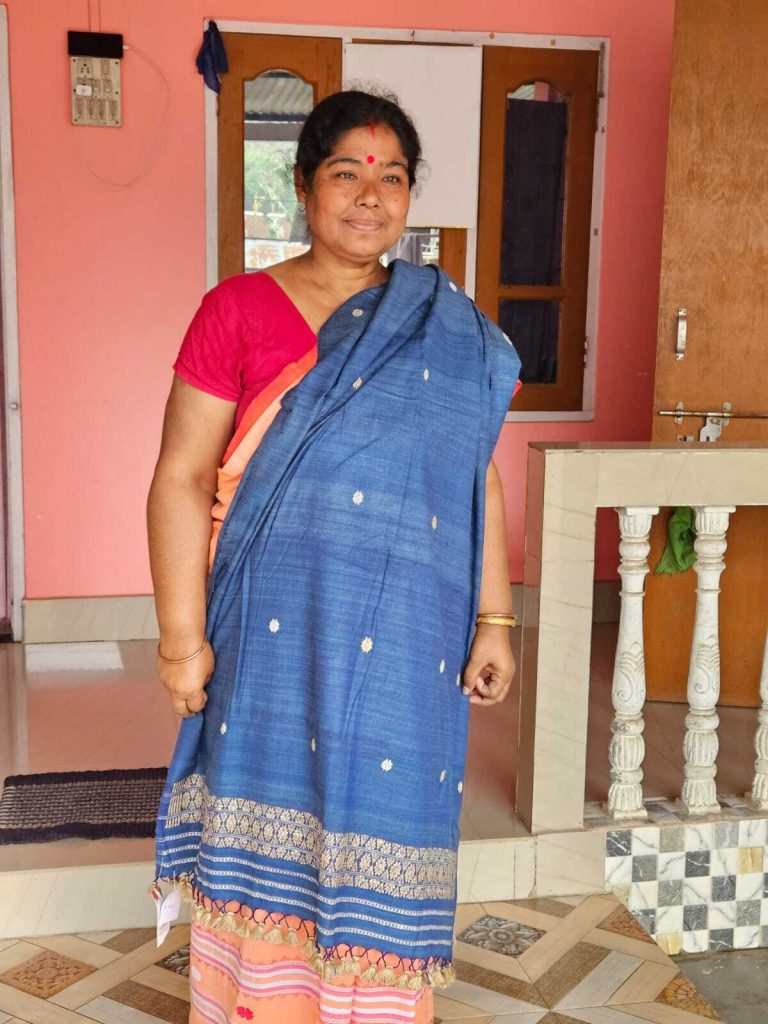
Vibha is a home-based, independent, private handloom entrepreneur. She stands on the raised verandah(2) outside her front door, her round face wreathed in smiles. She wears a mekhela chador – a traditional Assamese garment. On the right-hand side is a shed with two functioning Jacquard looms(3); two women rise from their work and step out to greet us. After a few formalities, they retreat into the shed while Vibha ushers us into the main residence. We take up the wooden couch; she pulls up a plastic chair. Between us, a coffee table stands guard, as if to maintain a sense of distance. She starts telling us her story.
Originally from Palasbari village, Vibha moved into her husband’s house a couple of decades ago. As a new bride, she discovered the reality of her financial situation – her husband did not work, and her marital home was a kuccha(4) hut. She managed to make ends meet doing odd jobs. In 2005, a daughter was born, followed by another one in 2009. ‘I was worried all the time (about money),’ she explains.
As a child, Vibha had learned the basics of weaving. When her daughter was young, she did job work spinning muga(5) silk into yarn. The earnings were meagre, and there was no growth. She confided in her parents about her marital and financial problems. To help her out, they offered her a substantial sum of money from the sale of some ancestral land they owned. ‘We were just two sisters, so you could say this was my share of their property,’ she said. Her parents hoped their contribution would help build a pucca(6) house for their daughter’s family. Vibha took the money, but she thought: ‘Ghar banane se toh mera paisa khatam ho jayega. Mereko kuch karna hai…iskeliye maine woh paise ek jagah me invest kar diya’. (If I built my house, all the money would get used up. I wanted to do something (more) and so I invested all of the money.) Vibha invested the sum into a Unit Linked Insurance Plan (ULIP).
In 2018, Vibha had the opportunity to work with a Non-Governmental Organisation (NGO) that trained women in the production of hand-woven silk and cotton products. ‘My daughters were old enough and I could leave the house (to work)’, she said. Along with a few other women from the village, she began visiting the local NGO office, where she received six months of training on topics such as improving product processes, communicating with clients and other stakeholders, and business concepts. ‘I knew how to operate a handloom(7) but didn’t know much about business. I (quickly) realised, if I wanted to start a business, I’d need to get someone else to work for me. If I worked the looms, then I wouldn’t be able to mind the business,’ she explained. Working with the NGO opened a whole new world for Vibha. She participated in exhibitions across various cities in India – Mumbai, Delhi, Jaipur and Kolkata and got access to real customers, conversing with stakeholders and rediscovering pride in her traditions. ‘Every time I travelled, I learnt a little bit more!’ she chirps.
Vibha received a Jacquard handloom from the NGO at no cost, and she invested in another one from her savings. She took a loan and built a work shed in her courtyard to house the handlooms, and presently employs two women from the village to work for her, weaving products such as sarees, mekhela chador, and stoles from muga silk. She also sources finished products from 10-15 other women in the village who sell directly to her. She pays them for every unit they produce. Vibha buys silk yarn in bulk for 30,000-40,000 rupees and sells finished products directly to the NGO or through exhibitions organised by them. She also takes orders from private clients through her Instagram account, earning between 15,000 and 30,000 rupees per month. She earns more if she sells at exhibitions. In the last 9 months, she has received a total of INR 9,000 from the government’s Mahila Udyamita Scheme, disbursed in three instalments. Her elder daughter supports the family income by baking and selling artisanal cakes.
On an average monthly basis, Vibha spends INR 7000-8000 on groceries, INR 1200 on utilities; she saves about INR 500-700 at home. She pays monthly insurance premiums and though she has a post-office account, she doesn’t save regularly in it. In 2023, Vibha applied for a loan of INR 5 lakhs through a Self-Help group (SHG) to expand her business operations. ‘I originally applied for a 5-year repayment period, but later realised I’d have to pay a lot in interest. So I changed my repayment period to three years.’ She is confident she can repay the loan on time. The costs of mobility are high for Vibha – a one-way trip to Guwahati city to stock up on yarn costs INR 200. This year Vibha’s older daughter started college in Guwahati city. Her fees and transport cost an average of INR 6000 a month, which Vibha covers from her accumulated savings.
For the past year, Vibha hasn’t been to any exhibitions as she is prioritising her daughters’ education – her elder is in college, and her younger has a couple of years of schooling left. Her main challenges are rising education costs and access to capital for business. In the next five years, she wants to invest in her younger daughter’s education and career. ‘I have already lost a lot of business by being at home for the past year’ She will have to support her daughter for one more year. Her elder daughter wants to become a scientist, but Vibha has asked her to adjust her dreams as she does not have the money to see her through. ‘As long as I am alive, I can support them. If I am dead, I can’t do anything, right?’ I understand that when the choice is between survival and dreams, the latter is often sacrificed. Vibha believes her financial life is better after coming in contact with the NGO– she earns a regular income and can also balance her housework. She doesn’t want to go out and work because it would mean neglecting her household. She advises other women in her circle to do the same – work at home and attend to the children.
Vibha owns a smartphone and uses social media and payment apps such as Instagram, Facebook and PayTM. Her current smartphone is too outdated and slow. An ideal smartphone would have a good camera to take better pictures of her products. She understands that better Instagram photos mean more sales. Someday, she would like to have a studio where she can photograph her products.
Using her savings, Vibha has built a small shop near her house, which is currently unused. She plans to stock it with yarn to save on transport costs – the surplus could be sold to other women artisans in the village.
Vibha says she needs time to buy stock and get the shop started. Once the shop is stocked, she hopes her husband will run it. She hints that he is unemployed but supports her by dropping their daughter off at school, shopping for groceries or accompanying her to the wholesale thread market in Guwahati. ‘When I see him just sitting around idly, an old anger rises in me. I don’t want to talk about my old life.’ she says. Vibha gets up, goes into the kitchen and comes back with two cups of laal cha and snacks. I take it as my cue to stop. As we chat, Vibha shows us her Instagram handle, which means “moon-rise”. She explains. ‘My life has been full of darkness, but my work brings me hope.’
Published June 2026. Authored by Valerie Mendonca.
(1) A metal pot filled with water, topped with mango leaves and a coconut, symbolising abundance, fertility, and divinity.
(2) A raised platform outside a typical rural house.
(3) A hand-operated loom fitted with a Jacquard machine to create intricate, complex patterns directly into the fabric.
(4) A temporary or semi-permanent dwelling constructed from low-cost, natural materials such as mud, straw, wood, bamboo, and thatch.
(5) Muga silk is a rare, exceptionally durable, and naturally golden-yellow silk produced exclusively in Assam, India. Highly prized, it is hypoallergic and known for its natural, glossy sheen that increases with age and washing.
(6) A permanent, durable, and solid residential structure built with materials like bricks, cement, concrete.
(7) A handloom is a manually operated, traditional weaving machine powered by human hands and feet rather than electricity, used to create textiles. As a non-mechanised device, it produces unique, textured fabrics (such as saris, cotton, and silk) that often reflect regional artistic tradition.