The Last Mile: Understanding Credit Access and Financial Behaviour Among Women Gig Workers
Cooks and cleaners account for 5.4 million of India’s 48 million urban women workers (Periodic Labour Force Survey, 2024). For many, aspirational goals such as upskilling, starting a business and unplanned shocks like medical emergencies create a pressing need for accessible credit. Far from a homogenous demand profile, women in gig work represent a diverse customer base, spanning highly independent, digitally savvy segments to low-trust, social-proof-dependent ones.
To measure this, women’s aspirations, their reasons for wanting finance, and their willingness to transact digitally — our portCo startup PayDay (a startup supported under the Bharat Inclusion Initiative) conducted a study to understand the credit behaviour of urban informal workers. While the larger sample size covered 433 people across 35 gated societies in Mumbai and Bengaluru, we focus on the sample of 385 women from the larger set. Digital infrastructure today already exceeds what most women in this segment currently use; our findings point to where technology can solve for trust and meet women where they are. The respondents included a diverse range of informal workers —
- 385 women who were hired-help- domestic workers (44%), cooks (26%) and the rest in other categories of informal work. 70% of the respondents were from Bengaluru, 30% were from Mumbai
- Almost 60% of the respondents were between 26–45 years of age (n=344)
Financial capability exists where financial literacy does not
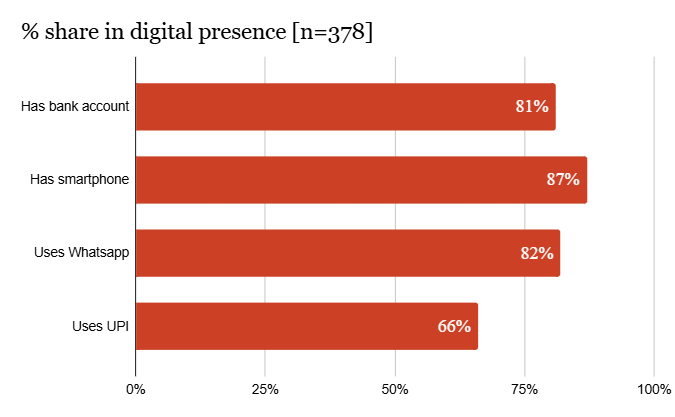
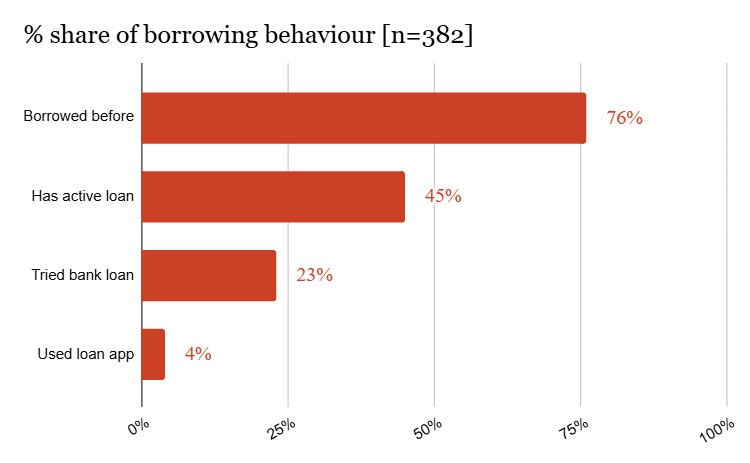
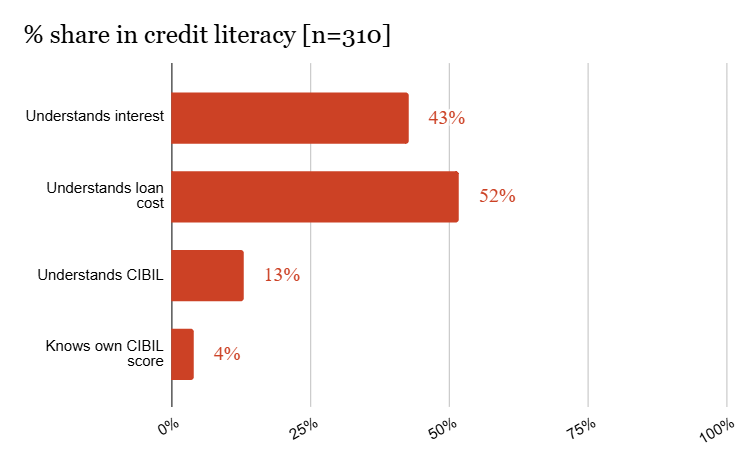
Fewer than 5% of the women knew their own credit score, and only 13% understood what a credit score is, yet 76% had borrowed before, and 66% were already using UPI for payments. Credit-specific literacy varied by dimension: 43% understood interest rates, while only 52% understood total loan costs. This gap, high financial activity paired with low financial literacy means product design needs to account for both low trust and low literacy, using technology that meets women where they already are in their digital journey.
Jeeva (45, cook, Bengaluru) is the clean example here. She’s paid via UPI, uses UPI and WhatsApp comfortably, and has borrowed before from her employer, repaid via salary deduction. But she has no loan from a formal source (bank or MFI), has never heard of CIBIL, doesn’t understand what it is, and doesn’t know her score, even though she does understand interest rates. Her own framing,“I don’t take advantage from anyone… kids say no to loans”, shows she associates “loans” only with informal, employer-based borrowing, not something a bank product could touch.
Access to formal sources exists, but reliance on informal sources still reigns
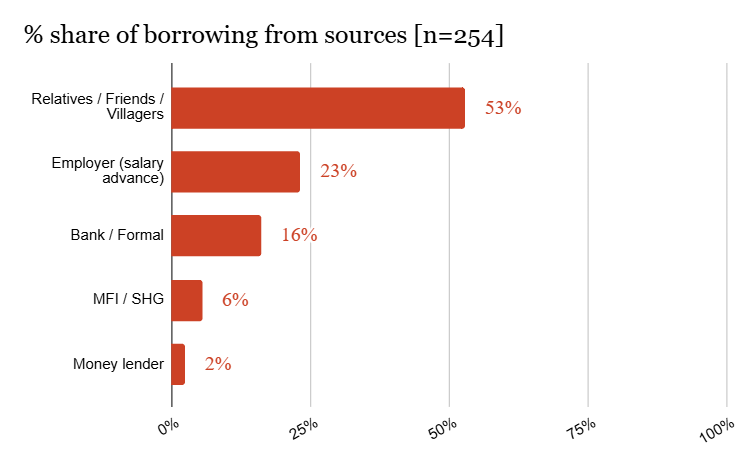
While most women had access to a formal bank account (81%), they relied heavily on informal sources of credit- 53% from relatives/friends and villagers. Sourcing behaviour varies significantly within both categories- formal sources split between banks and MFIs, while informal sources range from employers and moneylenders to relatives and friends.
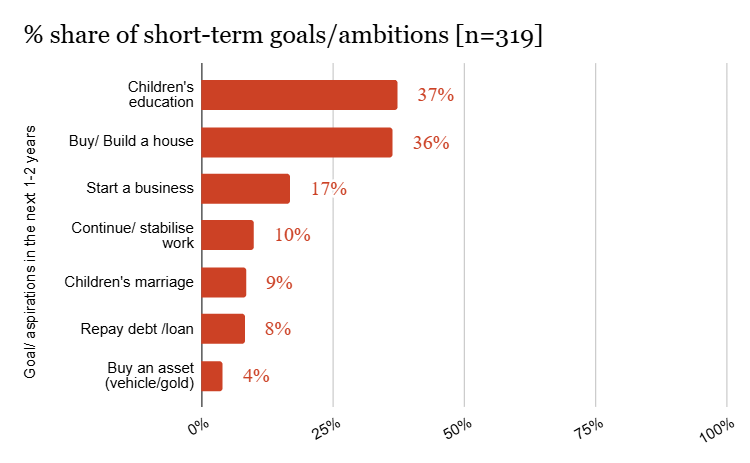
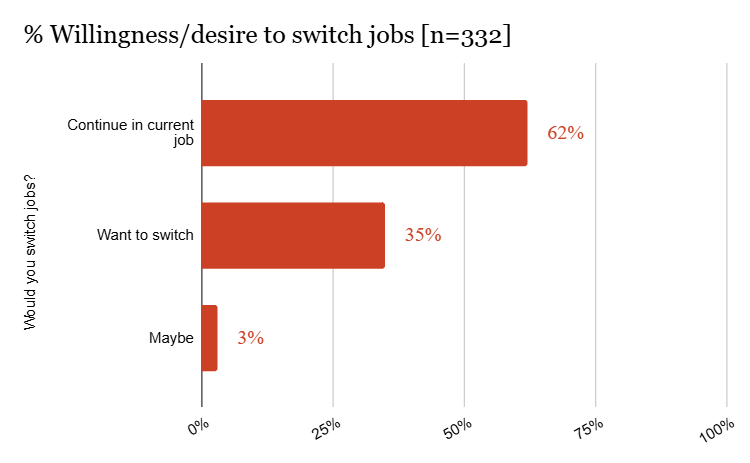
Women’s goals skew heavily toward family, not entrepreneurship: 37% prioritized their children’s education, 36% wanted to build a home, and 8% were saving for children’s marriage, compared to just 17% who wanted to start their own business. Job continuity was the norm too: 62% wanted to stay in their current job, versus 35% who wanted to switch.
When she’s needed money in a pinch, Ratna, 70, has gone to her employer for small amounts (₹2,000–3,000), repaid quietly through salary deduction, because it’s simply the most accessible option she has. Despite the constraints and recurring expenses for her husband’s injury, her ambition for the next year or two isn’t about herself at all, it’s to keep her children in school. Her own words sum up the frame she’s operating within: “We just work and eat.” And yet, when asked if she’d use an instant loan, she said yes, she isn’t closed off to something better, she’s just never been offered it.
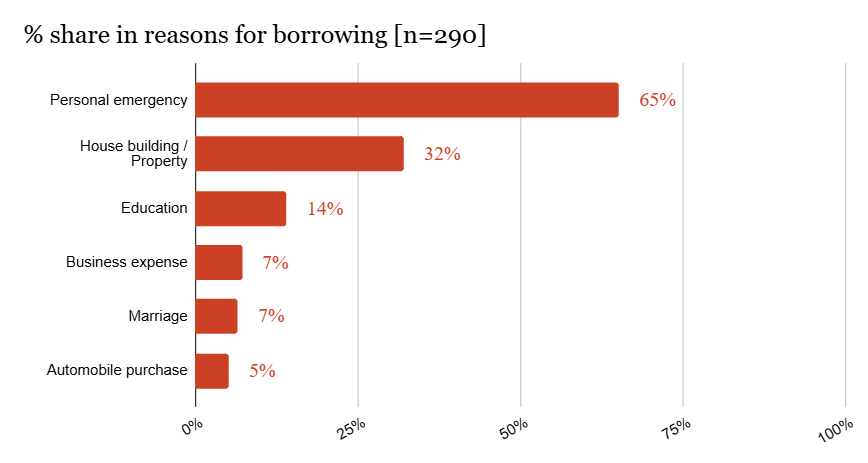
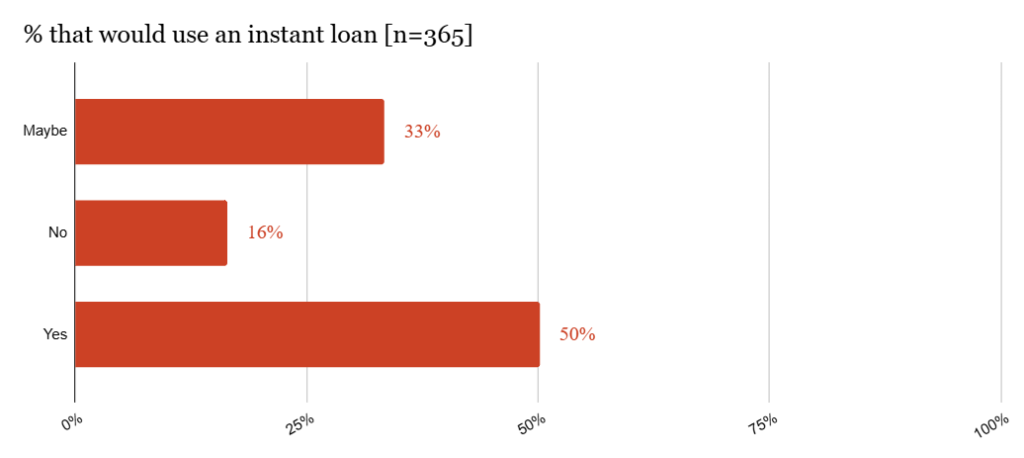
Reasons for borrowing were dominated by one factor: almost 65% of women borrowed for emergencies. This means credit products need fast, simple onboarding and quick disbursal, otherwise, they risk losing out to local moneylenders, who are often just a WhatsApp message away. This urgency shows up in appetite too: when asked if they’d want an instant loan, 50% of women said yes, and 33% said maybe.
Mahalakshmi, 36, a domestic worker in Bengaluru, needed money urgently for house-related repairs , an “emergency for house,” as she put it. Rather than going anywhere near a bank, she turned to friends, someone she could reach quickly and trust to be flexible. Her attitude towards instant NBFC loan is the same- a maybe.
Nagaveni, 35, in housekeeping in Bengaluru, faced an unspecified emergency and also borrowed from friends, repaying monthly. But she’s more digitally confident than Mahalakshmi, she uses UPI regularly and has a smartphone she’s comfortable with. Her attitude toward formal or instant credit is much more open: “Less interest? I’ll look.” She isn’t avoiding formal credit out of fear; she simply hasn’t been offered a fast, low-cost formal alternative, so friends remain the default not because they’re preferred, but because they’re what’s available in the moment.
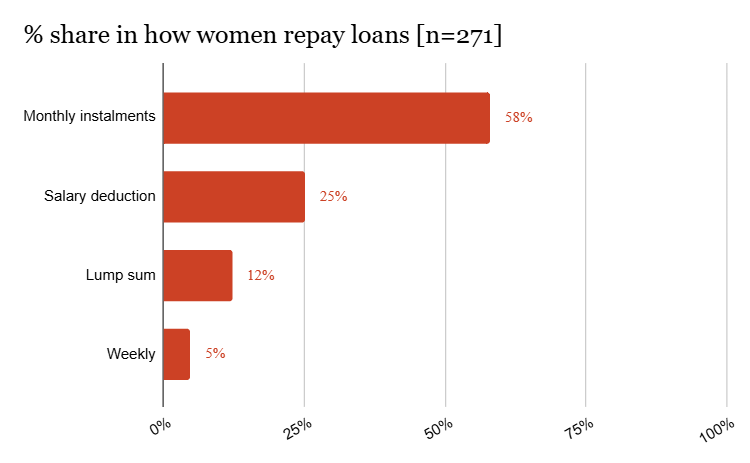
Almost 58% of women replied yes to monthly instalments, suggesting some overlap and familiarity with formal credit repayment cycles and their existing repayment methods (either informal or formal credit).
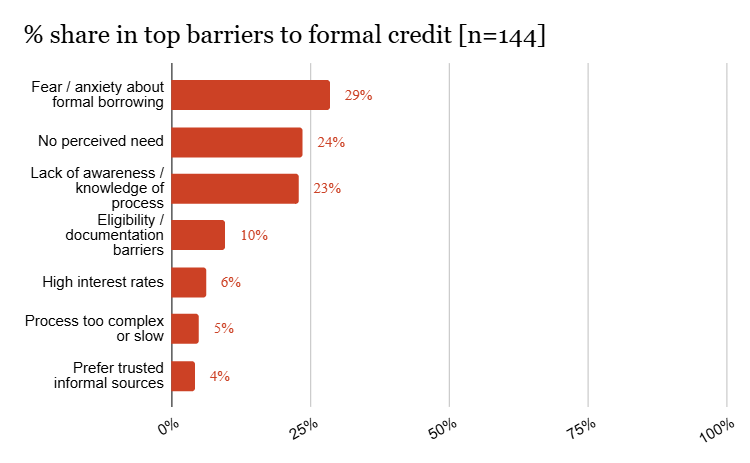
The top barriers to formal credit were fear of a repayment trap and lack of awareness of how the process works, both symptoms of a deeper issue: how creditworthiness itself is measured. Because a credit score only reflects formal credit history, women without that history default to assuming the worst, including excessive documentation and hidden debt traps. This points to a real gap: the formal system doesn’t account for alternative signals of creditworthiness, like consumption patterns or regular business cash flow, that could otherwise establish a strong financial track record.
Limited financial autonomy is a separate but significant barrier; 23% of women said they simply didn’t see a need for credit. This figure likely understates the true size of this group, since fewer than half the sample answered this question at all.
Our data confirms the demand exists, digital infrastructure is growing, and repayment capacity is real. But women’s credit behaviour is both consistent and varied: shared patterns like emergency-driven borrowing and openness to instalments sit alongside real differences by city, profession, and digital comfort. What remains unresolved is the distribution question- does a standalone app reach this segment, or does credit need to travel through an employer, an aggregator, or a trusted community intermediary?
The right answer likely differs across those same lines of city, profession, and digital comfort, which is exactly why treating this market as one homogenous segment has held it back for so long.
Published July 2026. Authored by Rohan Atrawalkar.