Women of Bharat: Gitika, Assam
Gitika is a petite, lean woman in her mid-forties. She is dressed in a simple white cotton saree, with pastel splashes along the border. Her tone is measured and even as she greets us at the entrance of her workshed. As she ushers us into the small room, I notice sunlight streaming in through the windows onto a loom. We sit on plastic chairs. Before we begin, Gitika informs me that she struggles to articulate herself in Hindi. But as our conversation unfolds, I find her to be a confident speaker, using Hindi and English, with some Assamese sprinkled in.
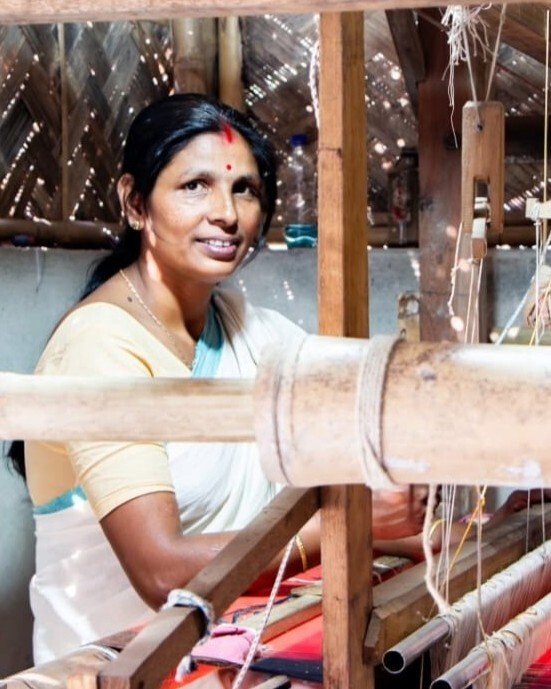
Photo Credit: From the respondent’s Instagram
Gitika grew up in a rural household in Bartari, a village in Kamrup district in Guwahati. Although she received a formal education till class 8th, she admits she struggles with reading and writing in Assamese and Hindi, the latter more so. Even as a child, she understood, “Ghar main bohot dukh tha, matlab gareebi tha. Kam nahi karenge toh nahi chalega.” (Our financial circumstances were dire; we were very poor. Not working was not an option.) She grew up watching and learning from her mother as she spun yarn, (1) and began working at 12 years old. During her youth, she worked at a local mahajan’s (2) farmstead four kilometres away, spinning yarn for their machines. She worked from 7 am to 4 pm for a pittance. She spun yarn and did some bobbin work (3) for a year before realising that weaving would pay better. She started working for a trader producing garments such as shawls for a meagre INR 80-100 per piece.
Married in 2003 at the age of 22 years, Gitika moved to her husband’s village on the banks of the Brahmaputra river. (4) She continued her weaving work on a loom that she had been gifted on her wedding day by her previous employer. In late 2004, heavy rains and an overflowing river caused catastrophic flooding, submerging several villages, including the one where she resided. Gitika, who was expecting her first child at the time, lost her home and all her belongings. Even two decades later, the depth of loss is evident when she talks about what the calamity cost her. With a slight tremor in her voice, she shares, “Mera ghar nadi ke thoda paas me tha. Mera kuchh nahi bacha.” (My house was close to the riverbank. I had nothing left.)
Gitika had to begin the painful process of rebuilding her life from scratch. She pragmatically asserts, “Kam nahi karenge toh nahi chalega. Baccha tha, husband ka kaam nahi tha.” (Not working was not an option as I had a child and my husband was unemployed.) Having lost her loom in the floods, she went back to working for a local mahajan. After a while, she plucked up the courage to ask a relative to lend her a loom, which she set up in a makeshift workshed adjacent to her rebuilt house. For several years, she earned INR 1,500-2,000 a month, which barely covered household expenses.
In late 2018, a non-governmental organisation (NGO) approached women in the village to offer support with crafting and selling woven products. Gitika perceived an opportunity to increase her income, explaining that, “Hum dusra mahajan ka kaam kar rahi thi aur itna fayda nahi mila.” (I worked for someone else and did not have much to show for it.) The NGO insisted on a six-month training programme, conducted in another village in Kamrup district, Bhagwatipara, where it taught the women about garment sizing standards, weave quality and communicating with buyers. Family finances were tight, and Gitika had to get creative to scrape together the bus fare, which cost her INR 60 one-way. She started working for local tailors, adding tassels to chadors. (5) She carried out the delicate work by hand, working all night under a single fluorescent lamp in her workshed. She was paid exactly INR 60 in the morning, which she used to get to her training centre. Work availability was unpredictable, and when she could not scrounge up the bus fare, she walked nearly 10 kilometres to Bhagwatipara.
During the training, Gitika learned Hindi to better converse with various stakeholders. The NGO supplied a Jacquard loom at no cost and provided financial aid to construct a pucca work shed—a simple bamboo structure with a sloped concrete roof—that could withstand Assam’s seasonal downpours. She has travelled to exhibitions in Mumbai, Hyderabad, Chennai and Jaipur with the NGO to showcase and sell her handloom products. “I can’t imagine what life would have been without them. They have taught us a lot and made a real difference (to people like us).”
At present, Gitika has three looms set up in her workshed—two Jacquard looms and a simple handloom for intricate handiwork. She makes sarees from eri silk (6) or pure cotton, with each one taking at least a week. She works with fragile raw materials that require advanced skill to handle. She cautions, “Dhaaga tootega toh mahenga padega.” (Broken threads are an expensive mistake.) This makes it difficult for her to find and hire skilled weavers to meet the demand for her products. I see some frustration in her expression as she shares that local weavers prefer to work on polyester blends for the local mahajans. According to her, they would rather make garments in two to three days using a less fussy, easier-to-handle material.
Health issues have severely limited Gitika’s own capacity to spend countless hours weaving. A few years ago, she began experiencing bad bouts of back pain as the physical stress of nearly 30 years of working on the loom caught up to her. She began buying woven garments from 10-12 other women in the village to sell at exhibitions. She has also employed one weaver, paying them between INR 1000 and INR 1500 per saree.
Gitika can sell an eri silk saree for INR 9,000 to INR 10,000. After reinvesting some of the income to buy raw materials, she takes home INR 10,000-15,000 each month. Her husband works at the local school, preparing the midday meal, which pays him a mere INR 1,000 each month. He does other odd jobs to supplement this income. They live with their two children, a son and a daughter, aged 21 and 19 years respectively, in a small 3-room pucca house. They rebuilt their abode on government-allotted land on the other side of the river a few years after the flood. Gitika’s workshed is attached to the house.
Gitika has not calculated how much they spend each month, but estimates that most of their earnings go towards running the household. Food and the children’s travel for their education are their biggest expenses at INR 8,000 and INR 3,000, respectively. Her son travels to a college in the neighbouring town by motorbike, making petrol a significant expense. The electricity bill averages INR 300-500; the family has a television but no fridge. Gitika mentions that they have two hens and a cow. She tells me, “Aur dukh hai mera. November mein ek badi gaye chori ho gayi, woh yahan galli se le gaya.” (I have more problems. Last November, my strong and healthy cow was stolen from this lane.)
Although Gitika has a bank account, her savings are minimal, and she usually withdraws them for business or household expenses. A year ago, she borrowed INR 1,50,000 from the local self-help group (SHG). She says, “Interest kitna hoga woh hume nahi pata. 18 mahine ka kishti bhar rahi hun.” (I don’t really know the rate of interest. I’m repaying in instalments over 18 months.) Earlier in the year, she took out a life insurance policy.
Gitika owns a smartphone, which she uses to run an Instagram page for her handloom business, receive mobile payments, and watch YouTube videos for entertainment. In a more hushed voice, as if sharing a secret, she tells me that a few years ago, she did not know how to use a phone at all! Now, she is confident in transacting digitally and has learned enough English to get business orders through WhatsApp and Instagram. She declares, “Bank ka zaroorat nahi hai, GooglePay hai.” (I don’t need to go to the bank because I have GooglePay.)
I ask Gitika about her future plans. She expresses a vague desire to expand her business but does not elaborate. She wishes to buy land and build a house for her son, for which she has been saving money for the past five years. She has not approached a bank to apply for a loan. She confesses, “Loan ke liye darr lagta hai. Loan wapas nahi diya toh dikkat ho sakta hai.” (I’m afraid of taking a loan. If I’m unable to repay, it will create a lot of problems.)
Fulfilling her aspirations is complicated by the reality of her health problems. Last year, the severity of her back pain made working impossible and medical intervention necessary. She sold the little gold she had, and her brother sold his bike to gather enough money to visit a private hospital in Kolkata. She spent nearly INR 2,00,000 on travel and treatment. Even now, the pain persists, and she finds it gruelling to continue working on the loom. Her husband dissuades her from working, “Whatever you have earned is going into medicines and doctors’ visits.”
For someone with very little, a single crisis—a natural disaster, a robbery, or a medical emergency—can seriously impede their quality of life. Gitika has experienced all three. Yet, she perseveres, “Roz dard hota hai. Par main zameen khareedne ka soch rahi hoon. Mein ghar ke liye soch rahi hoon. Kam nahi karenge toh nahi chalega.” (I am in pain all the time, but I want to buy land and build a house. I cannot do that without working.)
Published August 2026. Authored by Reeva Dani and Valerie Mendonca.
(1) It involves turning raw fibres such as cotton into usable strands.
(2) The term which conventionally meant ‘great person’ has evolved to mean someone who owns the means of trade or production. Instances include local merchants, land owners, dealers, bankers or moneylenders.
(3) Bobbin work involves handspinning threads onto a neat, manageable spool.
(4) A 3,000 km long transboundary river, which flows through northeastern India and is crucial for irrigation and transportation.
(5) Chador is the upper drape of the traditional two-piece attire worn by women in Assam, called Mekhela Chador.
(6) Eri silk is a type of ethically sourced silk from India’s northeastern states that is harvested without killing the silkworm.