The other internet: Infrastructure waiting to be adopted
India has almost 958 million internet users; more Jan Dhan account holders than the population of the USA, and a UPI stack that processes more than 20 billion transactions every month (that’s roughly 7500 per second).
But the benefits of this infrastructure favour those who have the most leverage. Keeping a gender lens on internet data makes it clearer. Let’s see what data says!
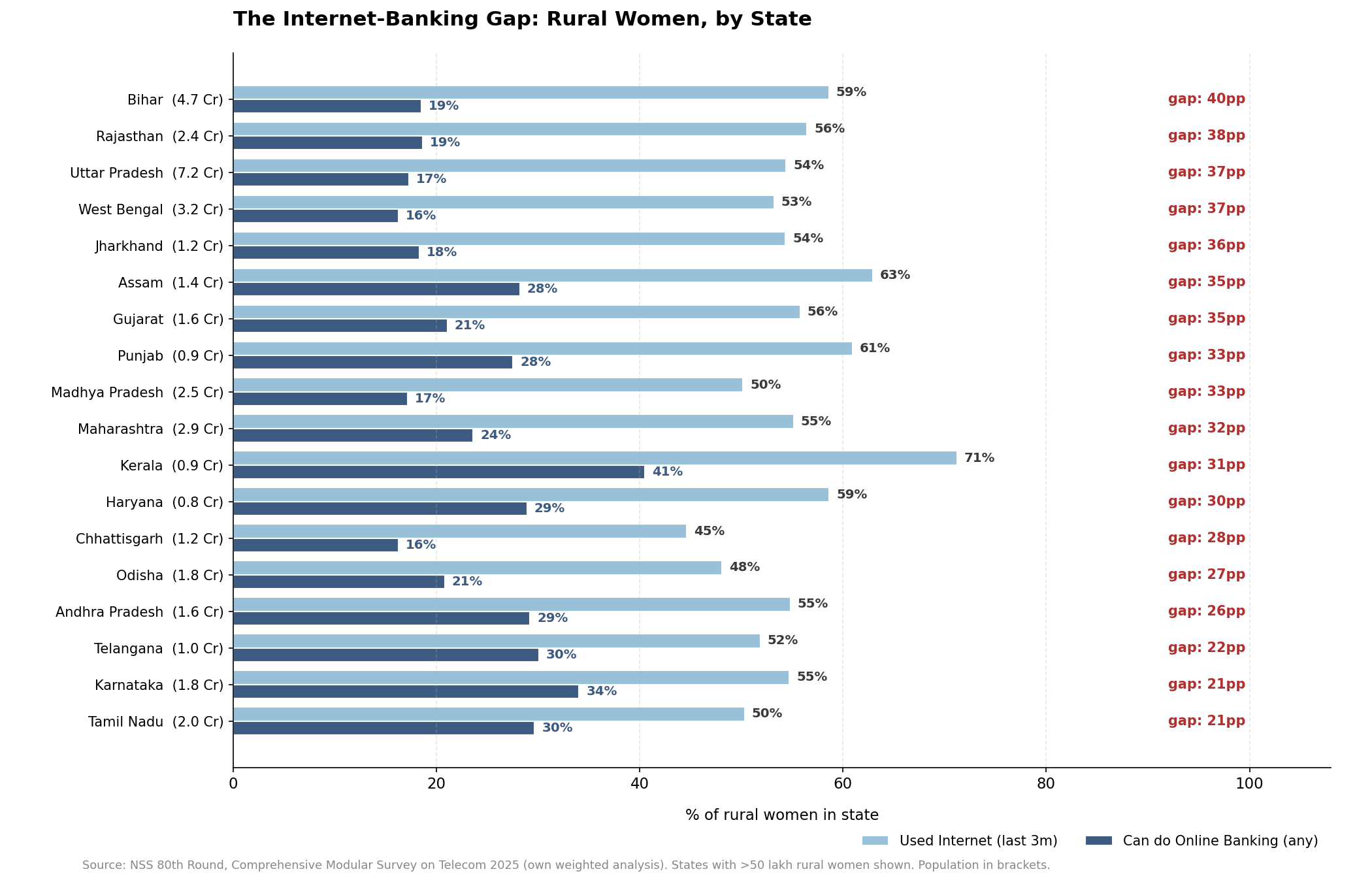
The NSS 80th round (2025) data (Comprehensive Modular Survey on Telecom) highlights a story of digitisation from the bottom up.
Rural women lag rural men on every digital indicator. Barely 1 in 4 rural women owns a smartphone compared to 1 in 2 rural men (19.6 percentage points gap). Only 22.2% of rural women can do any form of online banking, against 39.1% of rural men (16.9 percentage point gap). Even amongst women in the rural areas who actively use the internet, only 2 in 5 can transact financially. Finance has not followed the internet at the same speed.
The geographical differences within India require much deeper attention (figure 1). For example, in Uttar Pradesh, home to over 7 crore rural women, internet penetration is around 54% and online banking (including UPI) abilities of rural women are just 17.1% (i.e only 1 in 6 rural women can use the entire finance stack). In West Bengal, it’s 53.2% and 16.3% respectively. So what explains the gap? If it isn’t connectivity, and it isn’t literacy alone, what would actually close this gap? And who is going to build it? What these numbers represent is a huge market that is still untapped. Some cues could be in vernacular and voice first UI, and on ground assisted models, either in formal or informal setting, which can address this.
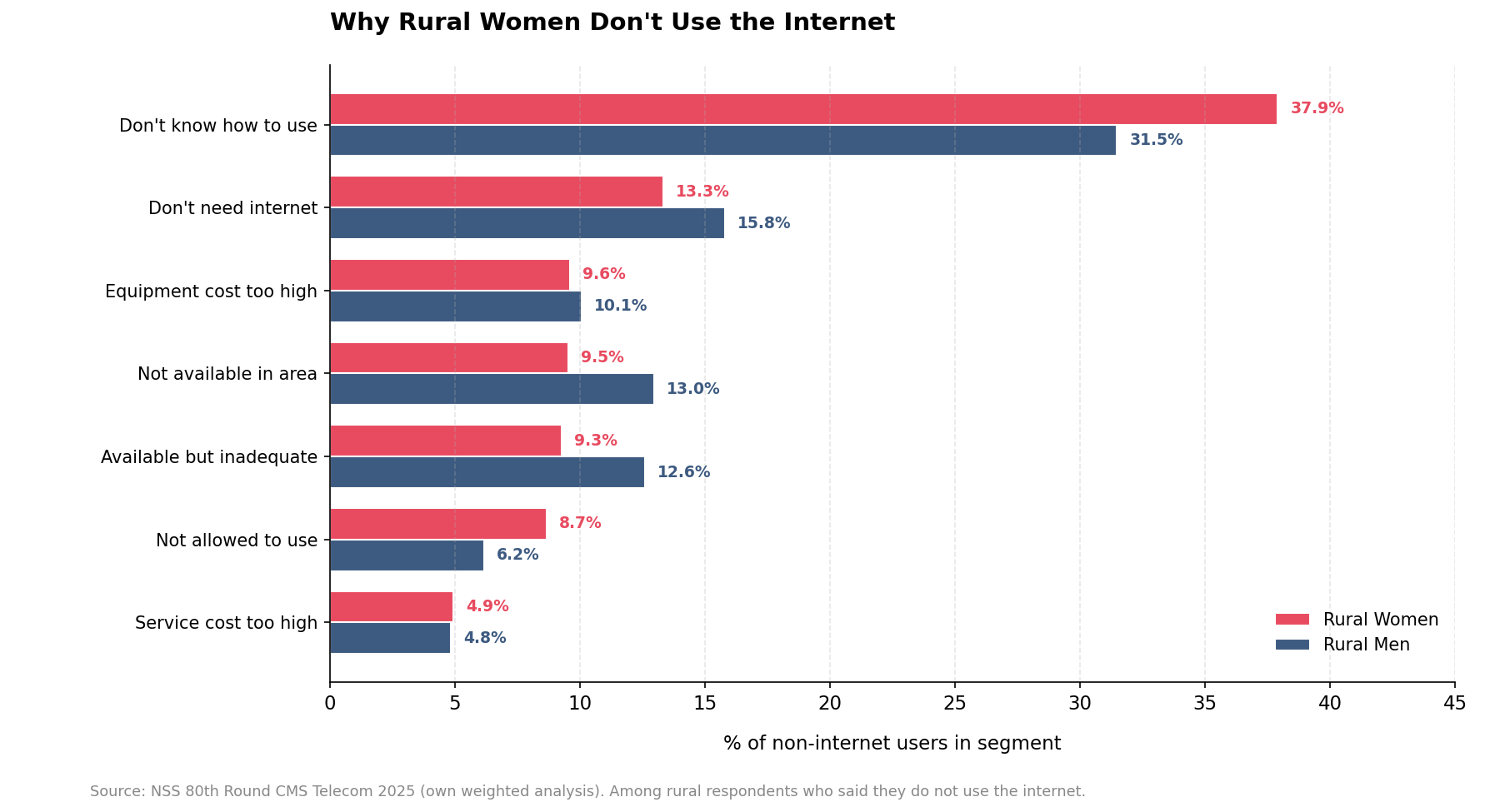
When you ask why rural women aren’t online, the NSS notes: 37.9% say they don’t know how to use it. IAMAI’s 2025 data notes similar points – 29% find the internet difficult and 32% aren’t aware of the benefits. Both sources indicate skill and awareness as the top reasons for not using internet, affordability-cost ranks lower.
The counter-narrative is also real. Rural internet grew 12.3% in 2025 when compared with 2024 numbers. This is four times faster than urban. Rural active internet users now stand at 548 million, which is 57% of all Indian internet users. IAMAI data also highlights that there are 135 million shared-device internet users, and 58% of them are women. However, these women have limited autonomy over when, how and for what they use the internet.
Another data point highlighted by IAMAI data: of India’s 958 million internet users, only 3% (25 million) use it for learning. Rural users account for 27% of that tiny base. This means 1 in 80 rural internet users are online for any kind of education or skilling. Consider this alongside the NSS finding: 37.9% of rural women who don’t use the internet report that the reason is simply not knowing how. The internet, when directed effectively, can serve as a tool to bridge that gap. The entertainment stack got built first because engagement is easy to measure and monetise. The skilling and financial literacy layer, the one that would convert a passive viewer into an active transactor, hasn’t yet been built for this user base.
- PhonePe is the world’s most downloaded finance app.
- In rural UP, fewer than 1 in 5 women can use it.
Both are true, showing contrasts. The next decade will be defined by whoever closes this gap.
Published May 2026. Authored by Vijeth Acharya.