Launch Economics: How Reusability Is the Cheat Code
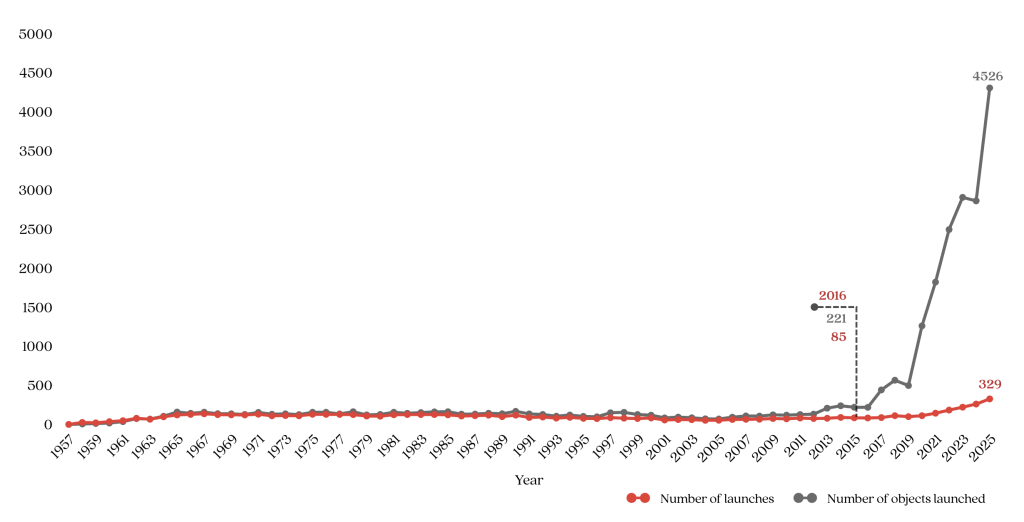
A rocket was launched every 27 hours in 2025. 329 in total, the highest ever in space history.
How?
Reusable rockets. The biggest innovation of mankind.
For the longest time (read more than 6 decades), boosters splashed down in the ocean and turned into an expensive reef. Now, the booster fires again, navigates itself back to the launch site, and lands. Vertically.
One private company made it possible. SpaceX. With a 97.7% landing success rate.
They managed to get the recovered booster ready to be used again in just 9 days – a world record. To build it from scratch actually takes months. The B1067 booster has now launched and landed 35 times as of June 2026 – again a world record. (B1071 and B1063 are close behind, with 34 and 33 reuses respectively).
SpaceX maintains an active, revolving fleet of approximately 21 reusable Falcon 9 first-stage boosters, which routinely cycle through launches, landings, and refurbishments to maintain the company’s unprecedented flight cadence. This allows SpaceX to launch two Falcon 9 rockets just 19 hours apart.
SpaceX executed 165 orbital launches in 2025, accounting for 51% of the global total. 157 of these launches used a previously flown booster. This isn’t just category creation. This is category domination.
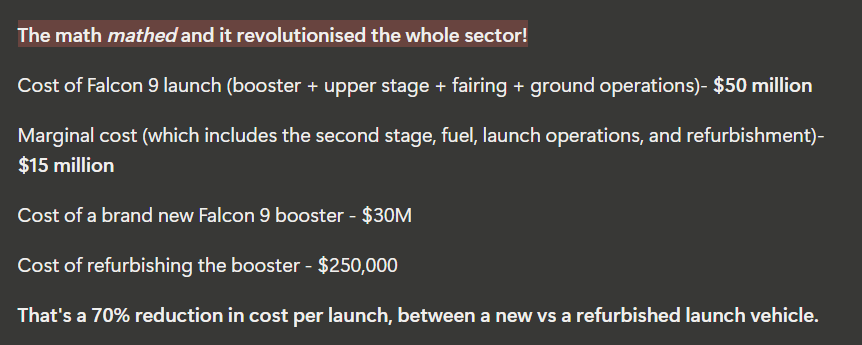
This innovation changed the economics of the sector. So much so that the cost per tonne to access space collapsed from $1.8 billion for Apollo 11 in 1969 to $6.5 million for Falcon 9 in 2025. That’s a 99.7% drop over 56 years.
This cost collapse resulted in a 19x increase in the number of objects launched in space in a decade, from 2016 to 2025. More than 4500 objects in 2025, raised from 221 in 2016. 85% of all objects that year were launched by SpaceX.
Houston, we broke the chart!
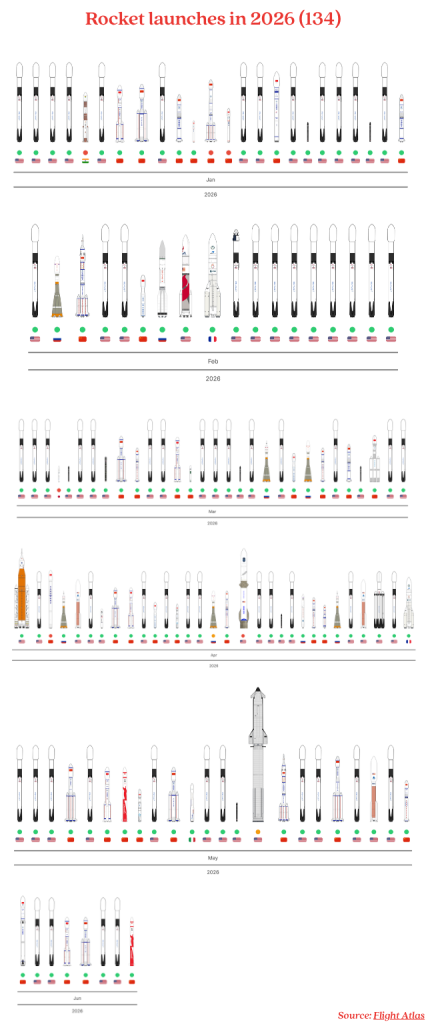
Halfway through 2026, 134 launches already. 74 launches by SpaceX. (as of June,2026)
But of course, we went looking for the Indian flag.
There’s one, the PSLV-C62 launch.
In 2025, India launched a rocket just 5 times. This is unsettling. Does India not have anything to launch?
It does. The demand exists. The payload exists. The willingness to pay exists.
Pixxel’s hyperspectral constellation is already in orbit. Digantara is tracking space debris from space. Dhruva Space has payloads flying commercially. GalaxEye sent the world’s first OptoSAR satellite into orbit.
So how did they get to space? Definitely not on the PSLV, which was once considered one of the most reliable rockets in the world; it put 104 satellites in orbit in a single launch in 2017. However, two consecutive failures (May 2025 and January 2026) have grounded that reputation.
So, Pixxel books SpaceX. Digantara books SpaceX. Dhruva Space books SpaceX. Even ISRO booked SpaceX when its own rocket couldn’t lift a heavy satellite.
Should we then replicate what SpaceX is doing?
No, India doesn’t need to out-SpaceX SpaceX. That race is already over.
We need small on-demand launch vehicles built for Indian payloads at Indian price points.
Which is exactly what ISRO did with SSLV (Small Satellite Launch Vehicle) with a payload of <0.5 T.
Democratising space means on-demand access at a lower cost. India is closer to that than most people think.
Falcon 9 does not fly till 22.8 T of payload is booked. And with monopoly comes leverage, raising the rates.
Today, if you want to put a 100kg satellite to LEO via SpaceX, the next slot is in Feb 2027, at least 6 months away.
6 Indian startups have sent 18 satellites into orbit, and more are planned. So there’s demand. Most of them were sent on a SpaceX vehicle, so there’s capacity to pay.
Private Indian players are still in the ‘launching-soon’ stage. While Skyroot’s Vikram-1 was a success, proof of repeatability is far from the launch pad.
There’s a payload pipeline, new customers, and willingness. What we need is launchers.
Published September 2026. Authored by Priya Mishra and Gaurav Khemchandani.