Journey to the Moon: How 11 deaf men made space travel possible
Apollo 11 made history. And, it took us 57 years to recreate that.
The Orion Spacecraft (Artemis II mission) flew four humans around the moon. They travelled a distance of 252,756 miles, which is roughly 10 times around the Earth or the entire length of India 126 times over. The distance is demanding. The engineering that made it possible is even more so.
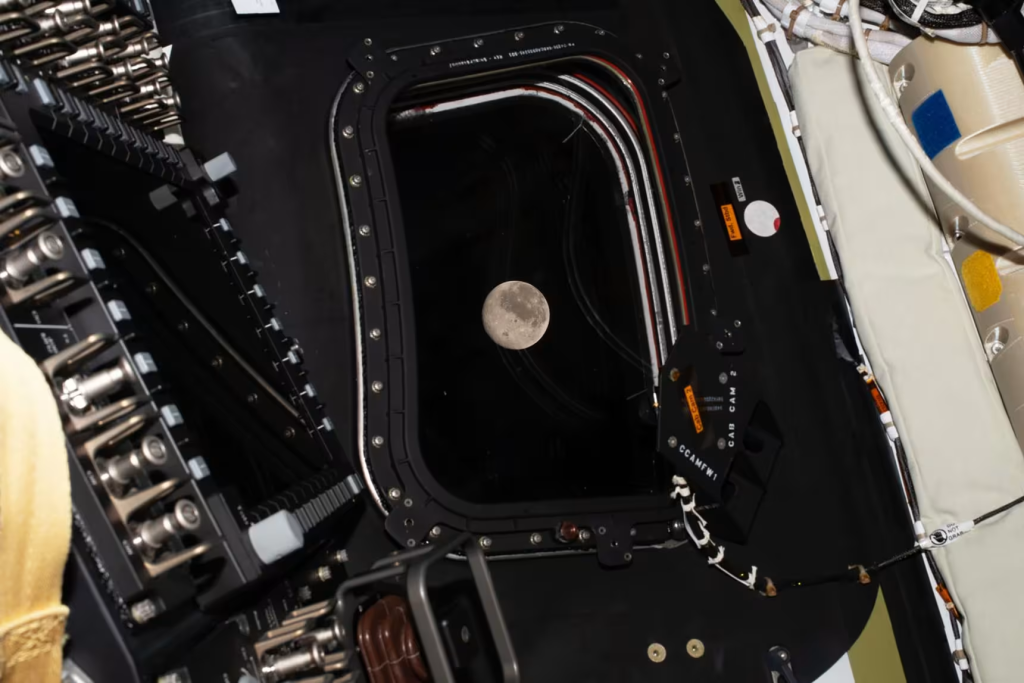
Just a different window (Day 5 of the mission, the Artemis II crew snapped a photo of the moon as it drew close in the window of the Orion spacecraft) [NASA]
The Orion spacecraft was launched using the Space Launch System (SLS), a 322 foot rocket. It took 2.76 million litres of propellant (a mix of liquid hydrogen and liquid oxygen that provides the best specific impulse for a chemical propellant) to launch it from Earth. At liftoff, SLS’s total launch mass was ~2.6 million kg, while the Orion spacecraft that reached the Moon weighed around 26,520 kg. That means roughly 99% of what sat on the launch pad was the fuel (and the rocket body) to propel the remaining 1% toward the Moon. And ~75% of the fuel was used in the first eight minutes of the mission.
How does one know the amount of fuel required to execute this?
Tsiolkovsky equation.
Δv = vₑ × ln(m₀ / mf)
This is the formula used by every space agency in the world.
Beyond rocket science
The science behind sending rockets to space was only part of the project. Equally (if not more) important was sending humans to space and ensuring that they could function in zero gravity and survive the pressure. And to bring them back. Alive.
It needed a Hail Mary, in the form of Gallaudet Eleven.
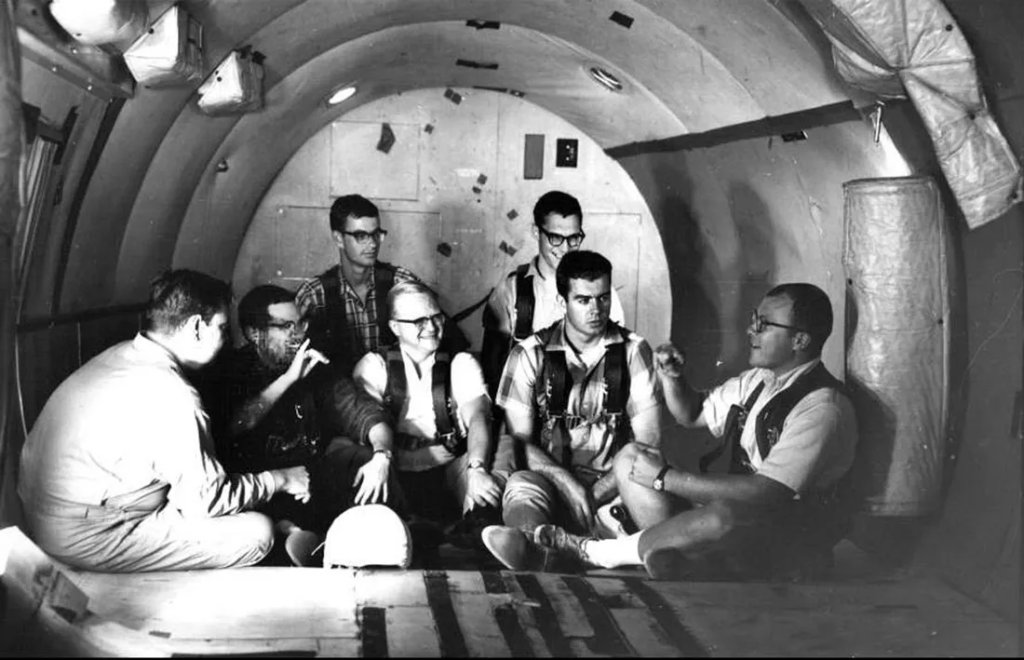
The Gallaudet Eleven – Harold Domich. Robert Greenmun. Barron Gulak. Raymond Harper. Jerald Jordan. Harry Larson. David Myers. Donald Peterson. Raymond Piper. Alvin Steele. John Zakutney.
Studies show that 60–80% of astronauts experience space motion sickness severe enough to impair coordination and cognition. For humans to reach space, it was essential to understand the effects of prolonged weightlessness on the human body.
Eleven men, who had been rendered deaf in early childhood by spinal meningitis, were the key to developing this understanding. These men volunteered to be the space subjects for a decade-long study conducted by NASA and the US Naval School of Aviation Medicine.
The disease had damaged the vestibular system of their inner ears, which is responsible for balance and motion sensing. They were spun at high speeds in centrifuges to simulate launch forces. They spent twelve consecutive days inside a 20-foot room rotating at ten revolutions per minute. They flew in the “Vomit Comet” (the notorious aircraft that creates brief periods of weightlessness by flying steep parabolic arcs) while researchers measured their eye movements, their balance, and their cognition. One had to draw his own blood while spinning in a centrifuge pod. Another wrote his signature repeatedly as oxygen was removed gradually from a sealed room; researchers gave him air only when his handwriting became illegible.
And then there was the North Atlantic voyage. Conditions so rough that the entire research team became incapacitated with seasickness, the Gallaudet Eleven sat at a table, perfectly comfortable, playing cards.
All of it turns out to be an engineering problem, solved thanks to them. Without this research, we would have had no Apollo or Artemis II missions.
Now, India?
On the same day that Orion splashed down, ISRO successfully executed the second Integrated Air Drop Test (IADT-02). On April 10, 2026, the Chinook helicopter dropped a 5.7T dummy crew module over the Bay of Bengal, validating parachutes that will bring Indian astronauts home.
India is now home to more than 300 active spacetech startups, having grown from just one in 2014. These startups have raised more than $920 Mn, ~75% of which was raised in the last decade. Privatisation of space changed the economics of the sector, and with it, who gets to play.
We have our first unicorn, Skyroot Aerospace. GalaxyEye launched an OptoSAR satellite. PierSight tested an in-orbit demonstration of Varuna (SAR satellite) and is gearing up for a launch in 2026. Olee has demonstrated a 20 km, 10 Gbps wireless laser communication system. Pixxel has 6 Firefly satellites already operational, and a contract with NASA has been inked. Dhruva Space raised a ₹105 crore grant for Project Garud.
Is 2026 the inflection point for India’s Space sector? Too lean to say.
India’s space success is a culmination of more than 60 years of R&D, and competing on a constrained budget. We work on a fraction of the budget allocation compared to other countries and still create history. India always had the capabilities and now with the private sector sharing the load, we’re solving for capacities.
The Moon doesn’t seem a far fetched entity, now.
Published June 2026. Authored by Priya Mishra and Gaurav Khemchandani.